Journal of Computer and Communication Networks
Peer Review Process
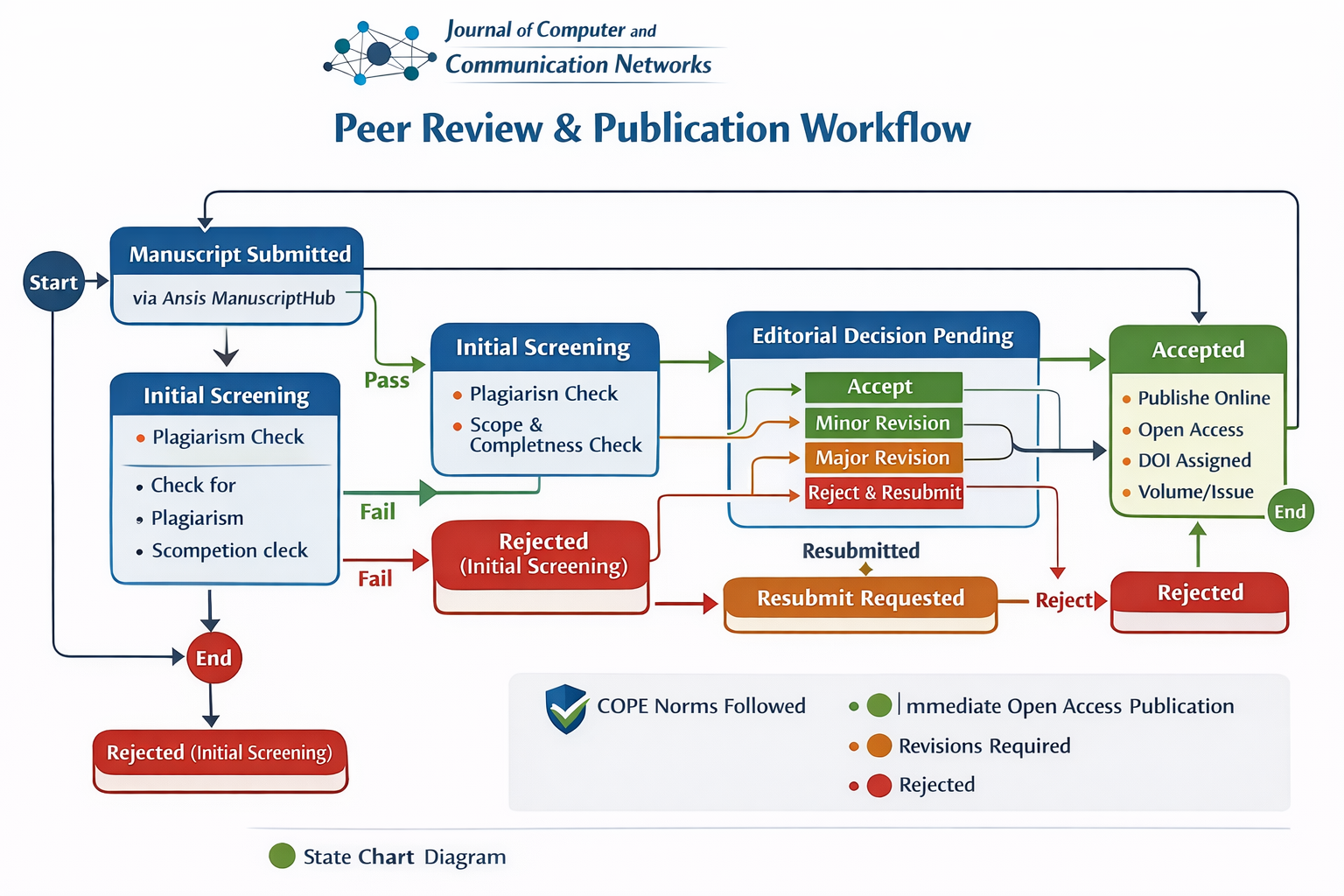
The peer review process is a central component of maintaining the quality, integrity, and rigor of published research at the Journal of Computer and Communication Networks. Every manuscript submitted undergoes thorough evaluation by Editorial Board members and independent reviewers, following COPE ethical guidelines and best practices for scholarly publishing.
The journal also operates under a continuous open-access publication model, ensuring that accepted manuscripts are published immediately online upon final acceptance, while being assigned a volume and issue number for indexing and citation purposes. Authors do not need to wait for issue compilation to make their work available to the global scientific community.
Submission and Initial Screening
All manuscripts are submitted through Ansis ManuscriptHub, our proprietary online submission and tracking system. Upon submission, the Editorial Office conducts:
- Plagiarism check using iThenticate/Crossref Similarity Check
- Initial assessment of the manuscript’s originality, quality, and compliance with journal guidelines
Screening criteria include:
- Alignment with the journal’s scope and aims
- Scientific quality, novelty, and clarity
- Compliance with Instructions for Authors and ethical standards
- Prior publication status (no duplicate submissions)
Conflict of Interest Management:
- Manuscripts from Editors, Guest Editors, or authors with potential conflicts are handled confidentially by an independent editor.
- For Special Issue submissions, if conflicts exist between Guest Editors and authors, a different Editorial Board member manages the peer review and final decision.
Manuscripts that do not meet these criteria are rejected without external peer review.
Peer Review
Manuscripts that pass the initial evaluation are assigned to the Editor-in-Chief, who designates a Handling Editor. The Handling Editor forwards the manuscript to at least three expert reviewers.
Key Features of the Peer Review Process:
- Double-blind review: Authors and reviewers remain anonymous to each other
- Reviewer selection: Based on expertise, independence, and absence of conflicts of interest
- Evaluation criteria:
- Originality and novelty
- Scientific accuracy and methodology
- Clarity, structure, and readability
- Ethical compliance (including COPE standards)
- Relevance and contribution to the field
Reviewer Recommendations:
- Accept
- Minor Revision
- Major Revision
- Reject
Reviewers are encouraged to provide constructive feedback to improve the manuscript, even when recommending rejection.
Editorial Decision
- A minimum of two completed reviews is required for the Handling Editor to make a recommendation.
- The Handling Editor forwards their recommendation to the Editor-in-Chief, who communicates the final decision to the authors.
Conditional Acceptance:
- Authors must revise their manuscript according to reviewer and editor comments.
- Revised manuscripts may undergo additional review before final approval.
Editorial Rejection:
- Manuscripts may be rejected due to insufficient quality, inappropriate scope, or ethical/technical concerns.
Continuous Open Access Publication
- The journal follows a continuous publication model, where accepted articles are published online immediately upon final acceptance.
- Each published article is assigned a volume and issue number, enabling proper citation, indexing, and DOI registration.
- This approach ensures rapid dissemination of research without requiring authors to wait for a compiled issue.
Benefits to Authors:
- Immediate global visibility of research
- Assignment of DOI and bibliographic details for citation
- Compliance with indexing requirements for Scopus, DOAJ, Web of Science, and other databases
Ethical Standards and COPE Compliance
The journal adheres to COPE Core Practices for:
- Ethical peer review and editorial decision-making
- Management of conflicts of interest among authors, editors, and reviewers
- Handling of publication ethics issues, including plagiarism, duplicate publication, data fabrication, or authorship disputes
- Ensuring transparency and accountability throughout the publication process
Authors, reviewers, and editors are expected to disclose potential conflicts of interest and follow COPE guidelines to maintain integrity.
Complaints and Appeals
- Authors may submit complaints or appeals regarding editorial decisions, peer review, or publication ethics via: jccn_help@ansispublications.com
- Complaints are handled confidentially and may involve consultation with independent Editorial Board members.
- Decisions on complaints or appeals follow COPE-recommended practices and are final after thorough review.